Nasario P. Mahinay
Faculty, College of Agriculture
Central Mindanao University
The evaluation of methane emissions from rice cultivation using alternate wetting and drying (AWD) irrigation in Valencia, Bukidnon, highlights the effectiveness of water management as a climate-smart strategy for irrigated rice production. Rice paddies are known for producing methane due to prolonged flooding, which creates anaerobic conditions favorable to methanogenic microorganisms. In contrast, AWD temporarily exposes the soil to aerobic conditions, reducing methane production, and is widely promoted as a methane mitigation and water-saving technology.
The study indicates that the irrigation regime significantly affects methane emissions. Continuous flooding restricts oxygen diffusion, fostering anaerobic decomposition and methane formation. In AWD plots, periodic drainage enhances soil aeration and soil redox potential, suppressing methane production. The AWD is a method of periodically draining and re-flooding fields, monitored with a water tube to identify irrigation needs.
Effective methane reduction depends on appropriate AWD timing and water-level management. Short drying periods may limit mitigation effects, while excessive drying can stress the rice crop during critical growth stages. Therefore, it is essential to balance emission reduction and crop performance
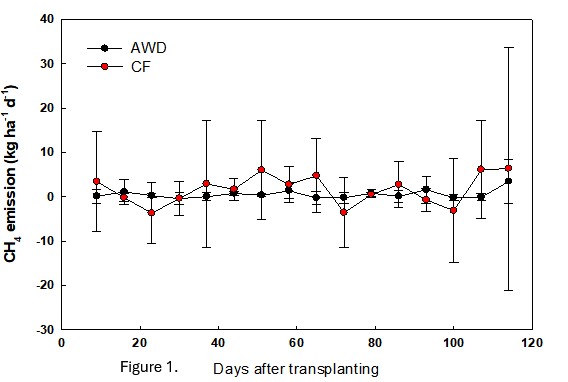
Figure 1 shows that the irrigation regime significantly affects methane emissions. Continuous flooding limits oxygen diffusion and promotes methane formation, while AWD enhances soil aeration through periodic drainage, leading to lower emissions. Results revealed that the continuous flooding treatment generally produced higher methane emissions than AWD, particularly around 50, 65, 110, and 115 days post-transplanting. Although AWD emissions were lower for most of the growing period, a noticeable increase occurred later in the crop.
In conclusion, the study indicates that AWD can effectively reduce methane emissions from rice cultivation while decreasing irrigation water use. This finding is particularly relevant for local rice-growing communities, but successful implementation will require careful irrigation scheduling, farmer training, and validation to ensure yields and profitability are maintained.
###