One planted the seed, another made it grow
When a Kagay-anon thinks of the name Limketkai, they often associate it with Mr. Lim Ket Kai who started with a small sari-sari store which grew into one of the Philippines leading conglomerates.
However, the history behind the name is far more interesting. While it’s true it was Mr. Lim Ket Kai from Quemoy, China, who migrated with his family to the small town of Cagayan de Oro, Misamis Oriental, and started a small sari-sari store from the savings of his wages working for another, it was his son Alfonso who made that seed grow into what has become today.
Alfonso is the middle child of nine siblings, two of whom have passed on. After finishing his mechanical and textile engineering course at the Mapua Institute of Technology, he first worked outside the family corporation before joining his father at age 26.
Although he was already working in an engineering firm with some of his schoolmates, his
father asked him a year later to join his business – an electronics manufacturing company – where he started as a salesman and was quickly promoted to sales manager. He was then transferred to the family’s Agri-manufacturing business as the Manila branch manager assisting his father and elder brother, Florentino, the executive vice-president, as the company’s corporate strategist and planner.

When Alfonso Lim took over the reins of his family’s business in 1980, he had an entrepreneurial spirit, an eye for growth, and a legacy to uphold.
“When my father and my brother Florentino passed away in 1972 and 1973, respectively, my eldest brother, Macrobio, assumed the presidency and board chairmanship, while I took over as executive vice-president. But after a few years, I assumed the president and CEO role of the company, and later took over as chairman of the board.”
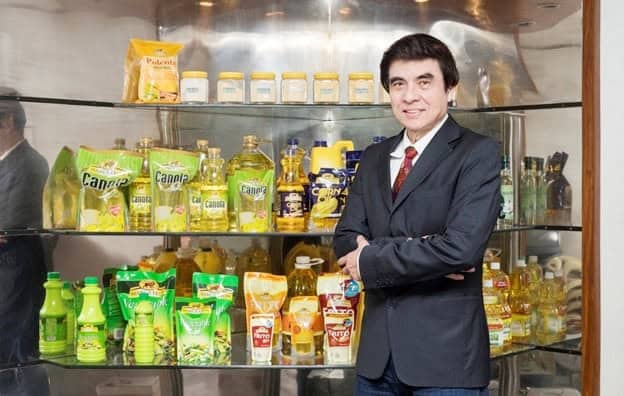
As Chairman and CEO of Limketkai Manufacturing Corporation (LMC), Alfonso’s hard work and determination steered the company from a small agricultural business into the Philippines largest manufacturer of corn products, while its sister company Limketkai Sons Inc. (LKKS) became the region’s leading real estate developer.
Alfonso Lim lives the gospel of working hard and playing hard. Every three months he flees the intensity of his business activities and for two weeks jaunts in Canada, Europe, North America, or China.
“I travel purely for leisure. My favorite place lately has been China, where I feel safe enough to backpack alone. I know I’m a workaholic so I need to get away to recharge,” he says.
Alfonso’s business philosophy and management culture is a blend of Chinese wisdom and Western concepts.
“I lead by example. I demand excellence from myself, and I expect my organization to strive for excellence and to perform at its best,” he says. “To maintain our lead in the industry, we must stay informed, reassess ourselves, innovate new products, and upgrade and expand our facilities. Alfonso mentions one Chinese proverb in particular that guides the way he does business, which roughly translates to ‘Be prepared for danger, even in times of safety.

“I am a strategist at heart,” says Alfonso. “I meticulously plan every business venture, always making adequate provisions for long-term eventualities. That’s my nature.”
Lim’s business philosophy seems plain but progressive. “Whenever I start something, I see to it that others are not yet into it. Or if people have done it, then I do it in a different way,” he says.
Lim says the road to the Limketkai Group’s success in the last five decades has had many twists and turns. Having a backup plan and a never-give-up attitude kept them on track.
The family started in rice and corn milling business but particularly corn which was far more profitable and easier to grow, especially in Bukidnon. Corn harvests, however, were simply sundried since there were no mechanical facilities yet available.
In the ’60s, he started to focus on drier silo storage for com and copra export then eventually went into coconut oil production. “We introduced the first mechanized drying silo storage to maximize the corm yield of two harvest seasons per year,” he recalls.
A manual drying method made corn prices highly vulnerable to seasonal changes. During the harvest season, which occurs during the rainy months, meant abundant corn production, but oversupply led to high spoilage and deflated prices. During the off season, production declined and buying prices rose.
“So, we thought, why not build a dry storage, so we can stock up on corn during harvest season and help more farmers by buying more of their produce? This healthy buffer, in turn, enabled us to sell high when it was off season.” They would go into corn milling and extraction of corn oil, which they sell under the brand Marca Leon.
Alfonso was commended for pioneering investments in corn silo storage with drying facilities, for his innovative strategies in corn oil extraction from corn bran and corn mill modernization, as well as for the success of the landmark Limketkai Center.
The group’s manufacturing arm, LMC, operates several millings, refining and manufacturing plants, grain drying and storage facilities, and distribution centers throughout the Philippines.
“We now have a comprehensive distribution system developed from decades of operational experience,” says Alfonso. This built-up network covers the whole Philippine archipelago with strategic sales offices and regional distribution warehouses in Luzon, the Visayas and Mindanao, encompassing all trade channels in support.
In 1971, they realized that corn oil, a by-product of corn bran, germ, and grits, was 20 times more valuable if properly extracted. But since the milling operation was traditionally a drying process, it was quite difficult to separate the germ from the bran.
“Corn germ contains about 30 percent oil, but if they get mixed up with bran, oil content drastically goes down to just 10 to 12 percent,” he explains. Mr. Lim convinced his father about the potential of corm oil extraction aided with laboratory test results to prove his stand; his father then stuffed corn bran inside a brown paper bag as his actual visual experiment. The following morning, the bag had become oily.
“Okay, you’ve proven your point,” he recalls his father saying, “so compute the feasibility study and do due diligence so we can build your oil extraction plant.”
Alfonso also saw the potential of exporting copra, which in the 1960s was just a locally traded commodity. The Arab-Israeli war at the Suez Canal yielded a big bonanza when copra prices surged tremendously.
“Because we stocked up on a lot of copra, we made so much money,” he notes. Another wave of unexpected profits came when the old Central Bank lifted the 20 percent dollar retention limit, so they were able to sell 100 percent of the export process in the open market.
However, import liberalization emerged in the 1990s, and a deluge of foreign brands made local brands less competitive.
“We are currently in the process of expanding our oil refinery operations, and building a new site in Luzon to supply China’s export market and meet the strong demand in Luzon and Metro Manila,” he explained. “This site enables us to increase our refined coconut oil production capacity while operating at a lower logistical cost compared with the present system, where products must be shipped long-distance from Cagayan de Oro to Metro Manila.
“The Philippines’ manufacturing sector is burgeoning and our manufacturing scope has expanded significantly, “he notes. Manufacturing comprises more than half of the Philippines industrial sector and accounts for almost a quarter of the country’s GDP. LMC currently enjoys 12 per cent of market share in the edible oils industry, ofthe more than 20 industry players in thePhilippine market, and dominates the region’s com retail market with 70 per cent.
“We remain committed to products of the highest quality, and we regularly upgrade our facilitiesand operations,” he says. As the largest manufacturer of corn products in the Philippines, LMC practices stringent quality control. “Through prudent leadership and effective management strategies, we continue to make inroads into the edible oil market previously dominated by rival international brands,” he said. As a result, the company has become the Philippines’ leading quality edible-oil provider, under its Marca Leon, Frito Plus, and Mazola brands.
LMC places a strong emphasis on innovation to become more productive and competitive. “Over the past decades, we have adjusted to the changing consumer market by introducing new product lines such as shortening and margarine for the bakery market,” he notes. “We have also expanded our corn products from animal feeds to food applications such as corn grits for staple foods, breakfast cereals and snack foods, as well as beer products for the institutional market.
“LMC has introduced coconut oil to the institutional market for their manufacture of filled milk, ice cream and spreads. We have also entered the budding Chinese market, where we have begun to export our coconut oil.” The emergence of health and wellness market prompted the production of a variety of lifestyle organic products. “We tapped into this trend by producing our own brand of 100 per cent organic coconut-sap sugar, made from local flowering coconut trees, under the brand Sorel Coconut Sap Sugar.”
Alfonso is focused on several key areas for growth across his real estate and agri-manufacturing companies. “Given the enduring success of the Limketkai Centre and Limketkai Luxe Hotel, we are confident of launching a hotel chain, shopping mall and other similar undertakings in Metro Manila and surrounding growth areas,” says Alfonso.
“The city is the financial, educational and political center of northern Mindanao, with people visiting for business and academic pursuits as well as entertainment, recreation and government transactions,” explains Alfonso. “We intend to capitalize on this popularity by developing 11high-rise residential towers in the Limketkai Center.” In its manufacturing division, LMC is expanding its corn storage and post-harvest com-drying facilities at Bukidnon to increase the stockpile during harvest season. It also plans to expand its coconut oil refinery complex in the Philippines in tandem with its oil storage logistics center in Shanghai, China.
“This center will have complete pier facilities, which are currently under construction, as well as a cold-storage warehouse to accommodate Philippine tropical food product imports – another exciting new business venture for us,” says Alfonso.
“We are also looking to join the envisioned Maritime Silk Road section of China’s ‘One Belt, One Road’ initiative, to tap the huge and growing market there,” he adds. Aimed at providing new infrastructure and economic aid to in-need countries, the scheme will connect 70 countries across Eurasia, Africa and Oceania through two routes – one overland and one maritime.
If its diverse and accomplished history is anything to go by, the Limketkai Group is looking at a promising future with Alfonso at the helm.
“Complacency is our greatest challenge. As a company, we must always aim to move forward and not rest on our laurels,” Alfonso concludes, his eye firmly on the future.
The Limketkai Group diversified into real estate development at the right time and at the right place, he says. Otherwise, the group would not have grown a balanced portfolio. “But as far as the country is concerned, there is a need to encourage more manufacturers, to encourage investment-related activity and not purely consumer spending,” he says.
References:
- From Corn to Construction by Holly Johnson and Jasper Salceda, The CEO Magazine, January 2018.
- Limketkai Group’s Alfonso U. Lim, Mountain Climber, Asian Dragon Magazine, November-December 2010.
- Corporate Profile of the Limketkai Group of Companies