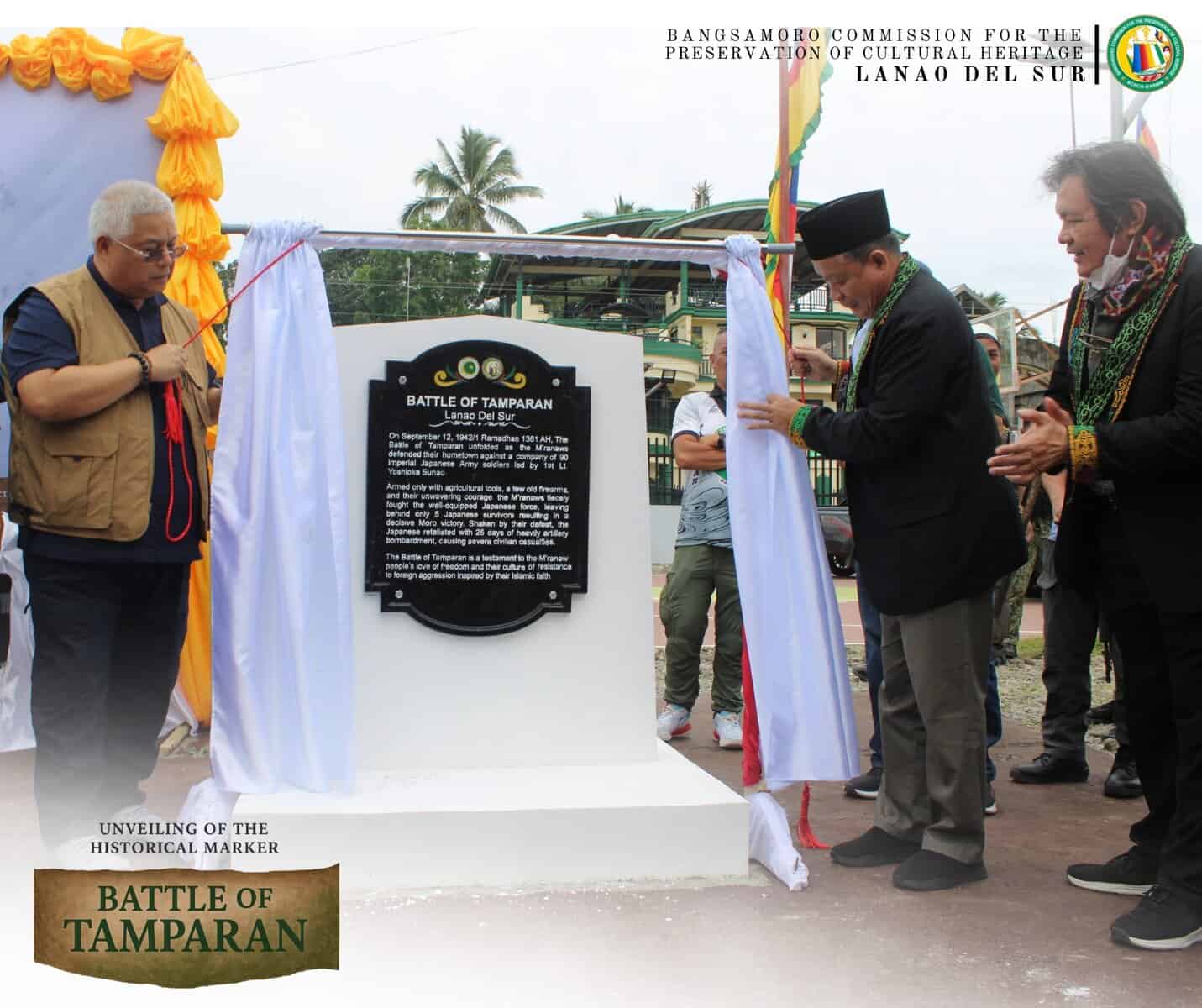
The Tamparan 300:
TAMPARAN, LANAO DEL SUR- In September 12, 1942, a Japanese company from Dansalan (now Marawi City) in pursuit of the Meranaw guerrilla Datu Busran Kalaw disembarked at the Tamparan wharf at dawn, during the first day of the Holy Month of Ramadhan.
Upon reaching the local settlement they found a kota (fortification) flying a red flag – a symbol of war. The unit deployed their mortars began shelling the kota, alerting the local populace. In response, a swarm of Meranaw civilians from Tamparan and the nearby communities of Taraka, Maguing, and Gata, armed only with panabas, and other bladed farm implements, fell upon the Japanese in a frenzy, furious the invaders dared to violate the Holy Month of Ramadan.

Outnumbered and running out of ammunition, the Japanese fled towards the marshland bordering Lake Lanao and the wharf where they were almost annihilated, with only five of the 90 soldiers escaping the onslaught. But it was Pyrrhic victory for the Meranaws who suffered
200-300 casualties themselves. According to a Meranaw survivor of the battle named Macolindang Krang who was interviewed after the war, the stench of the corpses was so terrible that no one could approach the site for two days.
Remembrance
On September 25, 2025, on the 83rd anniversary of the Battle of Tamparan, the Islamic Municipality of Tamparan, Bangsamoro Commission for the Preservation of Cultural Heritage (BCPCH)-BARMM and BCPCH-Lanao del Sur, unveiled a historical marker at the Tamparan Municipal Grounds to commemorate the valor and sacrifice of the Meranaw warriors in the historic battle that Sophia University Professor Emeritus Kawashima Midori said was notable for three points:
In her paper The Battle of Tamparan: A Maranao Response to the Japanese Occupation of Mindanao, published in the Southeast Asian Minorities in the Wartime Japanese Empire, in 2002, Dr. Midori said the annihilation of the Japanese company at Tamparan shocked the Japanese occupation forces so greatly they never again dared to venture in Lanao unless in overwhelming force.
The action also shattered the myth of the invisibility of the Imperial Japanese Army, inspiring the Meranaw people to step up their attacks on the Japanese occupation troops. Conversely, it also led to the execution of the American Brig Gen Guy O. Fort, the highest ranked US Army officer killed by the Japanese during World War II in the Philippines.
“This marker provides an opportunity to remember the battle and learn about our history. This is important not only for the Bangsamoro people, but also for Filipinos and Japanese people in general,” Midori said in a video message she sent to mark the occasion.
“The Japanese occupation of the Philippines left many scars, yet most Japanese people today are unaware of them. This marker provides them with an opportunity to acknowledge these scars, reflect on them, and learn from Japan’s past mistakes. Therefore, unveiling the marker does not mark the end of our quest for truth and peace. Rather, it signifies our continued commitment to truth and peace,” she added.
Historical Context
Similarly, BCPCH-Lanao del Sur Commissioner Robert M. Alonto explained the significance of the Battle of Tamparan in Bangsamoro history.
Under the Spanish timeline, the Bangsamoro Meranaws inflicted their first military defeat on the 1640 Spanish military expedition to Ranao, that they never again ventured in Ranao for 251 years while proceeding to colonize the rest of Mindanao and Sulu.
When the Spaniards returned, they besieged Kota Marahui under Datu Amai Pakpak from 1891 to 1895 and onwards to 1898, which were the last significant military engagements between Spain and the Bangsamoro people in the 333-year Moro-Spanish Wars that lasted until Spain’s defeat in the Spanish-American War.
Under the American Timeline, the most prominent historical landmark is the famous Battle of Bayang (Padang Karbala) also in Ranao on May 2, 1902 when the Bangsamoros in Ranao led by the Sultan of Bayang, were defeated by superior American artillery and firearms resulting in the death of 300-400 Meranaw warriors.
Forty years later, the civilian warriors of Tamparan, Taraka, Maguing, and Gata armed mostly with bladed weapons, annihilated elements of the touted-invincible Japanese Imperial Army which easily defeated the Western colonial powers – the Americans, British, Dutch and the French – in Southeast Asia, saw the first defeat of the Japanese Empire in the hands of the brave people of Tamparan in Ranao.
In the 1902 Battle of Bayang, the Bangsamoros were defeated by an invading modern foreign army. Forty years later, Moro martyrs in the Battle of Tamparan in 1942 had redeemed the Bangsamoros from that defeat by defeating an equally modern foreign army.
Islamic City of Tamparan Mayor Mohammad Juhar D. Disomimba cited how the program was an initiative of the Sangguniang Bayan members headed by our Vice Mayor Haroun Alrashid “Toxie” Lucman III.
Their commitment and leadership made this unveiling possible as part of our town’s anniversary celebration. Indeed, this is a legacy of leadership that honors the sacrifices of our ancestors while ensuring that Tamparan’s rich history continues to inspire us all. This event is not only a commemoration, but also a celebration of our identity as a people. The Battle of Tamparan is a chapter in our history that speaks of courage, resilience, and unity. The marker we are about to unveil is more than stone and inscription — it is a permanent reminder of the sacrifices of our ancestors who fought with honor and faith to defend this land and its people.
As we look upon this marker, let us remember that the freedom, peace, and opportunities we enjoy today were made possible by those who came before us. Their bravery is our inspiration, their faith our guide, and their unity our strength.
Especially for the youth — may this history remind you that the future of Islamic Municipality of Tamparan is built upon the sacrifices of the past. My dear brothers and sisters, the theme of our 65th Araw ng Tamparan —”Sustaining Unity, Advancing Progress for All” — resonates deeply with today’s unveiling. Just as unity gave strength to our ancestors during the Battle of Tamparan, it is unity that will guide us toward lasting peace and progress, in shaa Allah.
-30-