By JB R. DEVEZA
MindaNews
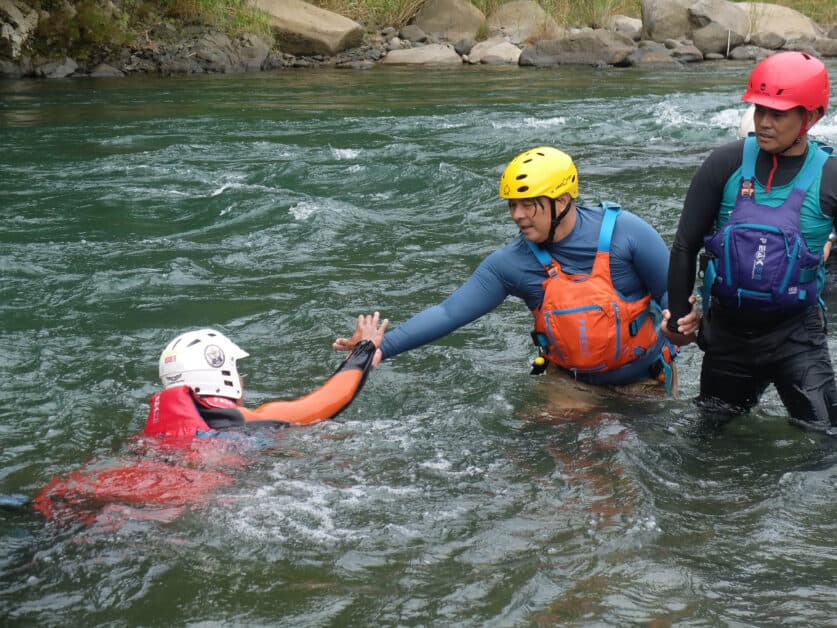
CAGAYAN de Oro City — It was forty-five minutes past noon on Wednesday. On a rocky river bank of the Cagayan River, near where crisscrossing streams cascade from the canyon top to merge with the river below, a dozen outdoor professionals and first responders were standing at a ready, listening to instructions on how to perform a drill, a drill that may someday save lives.
The twelve—a retired fire inspector, three firemen from the Bureau of Fire Protection-Davao, a lifeguard instructor, and seven outdoor professionals—were participants in the Swiftwater and Flood Rescue Technician course, a training especially useful for a country that, according to Pagasa, is ravaged by typhoons at least 20 times annually.
The training was the brainchild of two men, a Filipino and an Englishman. Chisum Factura, one of Cagayan de Oro’s whitewater rafting pioneers, began conducting Swiftwater and Flood Rescue Technician courses (SRT) in 2019 with Leo Hoare, a British paddler and kayaker who once represented the United Kingdom at world cup and world championship canoe slalom competitions.
Factura is no stranger to doing rescue work. His outfit, Kagay Whitewater Rafting, has a long history of being called upon by the city to do search and rescue work.
In December 2011, Kagay was among those who responded to calls for help during Cagayan de Oro’s worst tragedy.
Hoare, who is the SRT trainer, is a member of Rescue 3 Europe, a training organization founded in the US by whitewater professionals and firefighters. Hoare was among the first to be trained in 1998.
Rescue 3 curricula and training methods have since been adopted by the majority of emergency and rescue services across the UK, such as mountain rescue, lowland rescue, ambulance HART (Hazardous Area Response Teams), and police teams.
Factura said he picked his home river as the training venue because of its rather unique qualities.
The Cagayan River is one of the rivers draining the northern part of Mindanao and has its headwaters at over 2,000 meters in the Kalatungan and Kitanglad mountain ranges.
It snakes through the municipalities of Talakag, Baungon, and Libona, merging with tributaries along the way, before finally emptying into Macajalar Bay.
This significant drop in elevation creates many fast-flowing sections, or whitewater to outdoorsmen and mountaineers.
The zeal that drew Factura in the 90s to join the pioneering crowd of whitewater rafters is igniting a familiar passion, this time not only for recreation and tourism but to share his know-how in safely navigating swift water.
Hoare, for his part, said Cagayan River is ideally suited for SRT trainings. Hoare said the river has water year-round that is consistent and predictable, making it safe and ideal for trainings.
Hoare, who recently graduated from the University of Leicester with a Master of Science degree in Risk, Crisis and Disaster Management, has a long involvement in paddling as a sport and as a rescue professional. His association with the British Canoeing and Rescue Emergency Care has enabled him to develop qualifications and awards, produce resources, run pilots, and fine tune course content.
In doing the SRT trainings, Factura said their goal is twofold: to strengthen disaster preparedness and to protect the lives of emergency responders by giving them access to standardized and time-tested lifesaving techniques.
“We want our personnel to be properly trained, equipped, and certified to respond effectively to urban flooding, river-related incidents, and water-based emergencies,” Factura said.
For retired Laguna fire inspector Rommel Sanglay, one of the 12 participants, the SRT training fills the gap in the rescue courses typically given to first responders.
Sanglay said while many first responders are proficient in open water rescues, their training is deficient in responding to flood or swift water events in which flood hydrology— the movement, distribution, and properties of water—plays a big part. By definition, swiftwater involves water over two feet deep that is flowing at a rate greater thanone knot (1.15 mph) and occurring in a natural water course, flood control channel, or a flood-related environment.
This lack of training and knowledge can be deadly. On September 25, 2022, five rescuers were killed in a flash flood in Barangay Camias in San Miguel, Bulacan, amid the onslaught of Typhoon Karding. The rescuers were all members of Bulacan’s Provincial Disaster Risk Reduction and Management Office (PDRRMO) out on a rescue mission. All five drowned in more than 6 feet of fast-moving flood waters.
Sanglay said at times, he fears for his two sons, both members of the Philippine Coast Guard (PCG). The PCG, whose mandate is primarily for maritime search and rescue (SAR), is often called to respond to river and flooding rescues along with BFP, police, Army, and provincial and city DRRMO teams.
“I have two sons in the Coast Guard,” Sanglay said. “I don’t want them to die.”
Sanglay, who had to pay for the training out of his own pocket, said he plans to cascade the lessons to his sons, like lessons on hydrology and how water behaves. Lessons on recognizing eddies, standing waves, and recirculating water; on recognizing hazards such as obstructions that act as sieves and on looking out for undercut rocks or obstacles that can be deadly for swimmers.
Sanglay and the others will also be taught practical water skills, advanced rope work, and about using technical equipment as well as be made to undergo simulation, scenario-based drills both during daytime and at night.
Hoare said, however, that the training has some limitations.
“We can’t simulate cars in the water, hazardous material, electrics, we can’t simulate these,” Hoare said.
“The take away, really, I think for the rescue teams, is they’ll have a real-life experience, a lived experience,” Hoare said.
“So when the water comes, they’ll have an accurate perception of the risks,” he said.
And that, to the father of two coast guard men, is a take away worth his while. For the water does come. At least 20 times a year.